Strong grant proposals are built on clarity from the very beginning. The strongest ones make it easy to understand three things immediately.
- What problem exists
- Why it matters
- How the organization is positioned to address it
When those elements are clear and aligned, the rest of the proposal falls naturally into place.
Achieving this clarity, however, requires a simple but critical discipline: separating the need from the strategy.
When that line is well defined, everything else becomes easier to defend. The logic tightens, the narrative becomes more focused, and the proposal reads less like a request and more like a well-reasoned case for investment.
This is the foundation the team at Communication Mark uses to build stronger, more fundable proposals — and we’re giving you a step-by-step walkthrough of this process, our Needs & Strategies Framework, right now.
Part 1: Defining the Need
Every strong proposal starts with a clear understanding of the real-world problem it aims to address. That means focusing on conditions affecting the community, not the organization’s internal challenges.
This is where many proposals lose momentum. Instead of describing the issue facing people, they focus on what the organization lacks, like staffing shortages, limited space, or funding gaps. Those challenges may be real, but they’re not the core problem funders are trying to solve.
A true need exists whether the organization is there or not. For example:
- A ride service is responding to seniors missing medical appointments because there is no local public transportation.
- A youth program is responding to students falling behind academically due to inconsistent support outside the classroom.
That distinction changes how a proposal is received. It shifts the focus from organizational limitations to community realities, which is where funders are trained to look first.
When a Condition Becomes a Consequence
Another common weakness in proposal writing is stopping at description instead of explaining the impact.
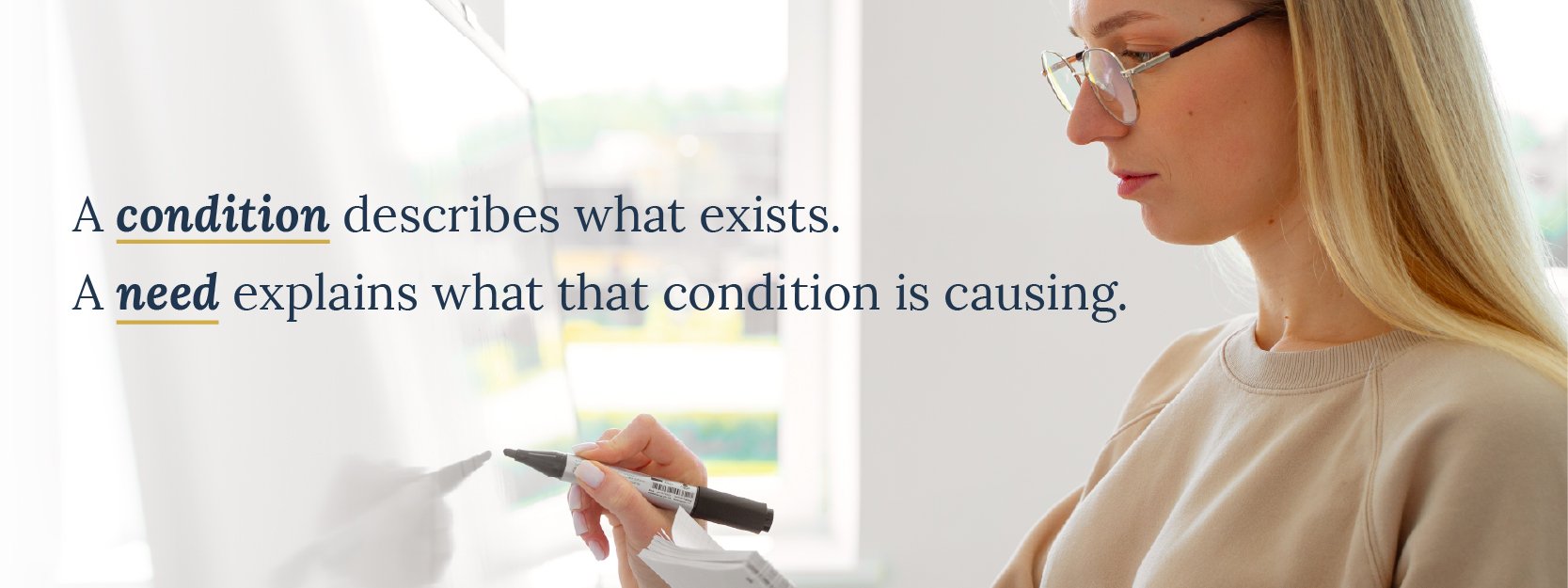
“Access to mental health services is limited” describes a condition. “Untreated mental health conditions are contributing to rising crisis intervention calls and emergency hospitalizations,” explains the consequences of that condition.
Funders respond to clarity about what is at stake. Strong proposals consistently answer the underlying question: What happens if nothing changes?
When that answer is clear, the need becomes compelling.
The Role of Evidence in Establishing Reality
Strong proposals move beyond claims and into proof. Funders aren’t simply evaluating whether a problem sounds important. They’re evaluating whether it has been demonstrated at a meaningful scale.
That is where evidence matters. Census data, public health reports, school district findings, and community assessments help translate lived experience into measurable reality.
Compare these two examples:
- “Food insecurity is a challenge in our county.”
- “One in three households experiences food insecurity, while school-based hunger interventions have increased by 40% over the last three years.”
One statement introduces a problem. The other establishes urgency, scale, and credibility.
When Data Meets Human Reality
Data alone rarely carries a proposal. This is where narrative becomes valuable, not as a replacement for evidence, but as reinforcement.
A well-placed story can turn information into something memorable:
- A working parent choosing between childcare and lost wages
- A student trying to complete homework without internet access
- A senior missing important community updates because information is inaccessible
Stories help humanize the data without weakening the proposal’s credibility. They connect statistics to real experience and help readers understand the impact behind the numbers.
The Strongest Needs Are Universally Recognized
Keep in mind that the most persuasive needs are rarely controversial. They don’t require a reader to adopt a particular worldview before understanding their importance. Instead, they’re grounded in issues most people already recognize as essential, like safety, health, and education.
This is important because when the need is framed clearly and universally, funders can focus less on debating the problem and more on evaluating the solution.
Part 2: The Strategy
Once the need is clearly defined, the proposal must answer the next question: What is the right response, and why?
This is where strategy comes in.
Strategy is often confused with programming or services, but it operates at a higher level. A strategy explains the reasoning behind the response, not just the activities themselves. It connects the problem to a deliberate plan of action.
Strategy as Intentional Design
The strongest strategies are designed specifically in response to the need, with careful attention to feasibility, reach, and long-term impact.
For example, if the issue is social isolation among visually impaired residents caused by inaccessible information, a radio reading service is a targeted response to a clearly identified barrier.
Good Strategy Feels Inevitable, Not Invented
The most persuasive strategies feel grounded in practical reasoning, not random or overly ambitious. They feel like the response that makes the most sense given the circumstances.
Often, that means demonstrating that other approaches were considered. In our radio reading service example, these could include:
- A volunteer visitation model may have lacked consistency or scalability.
- Printed Braille materials may not have reached the full audience effectively.
- Digital-only solutions may have created accessibility barriers.
Acknowledging those considerations shows thoughtful planning and helps build confidence in the chosen approach.
Strategy Strength Comes From Organizational Fit
A strategy becomes stronger when it aligns with what the organization is already positioned to deliver. Funders look for this alignment because it signals execution capacity, not just good ideas.
When the proposed work fits naturally within the organization’s expertise, infrastructure, and experience, the proposal feels more credible and achievable.
Part 3: The Vocabulary of Victory
Strong proposals are easier to trust when the structure is clear.
Funders want to see that an organization understands how its work fits together, from vision to implementation. Terms like goals, objectives, outcomes, and tasks help create that structure. When used correctly, they create a logical framework that guides the reader through the proposal without confusion.
Goals Define Direction
Goals define the long-term direction of the work. They define the broader change that the organization exists to create over time. Examples include:
- Reducing isolation among visually impaired adults
- Improving literacy outcomes for children
- Expanding access to essential community services
Clearly defined goals give the proposal its center of gravity. They hold everything else in alignment with the mission.
Objectives Define Measurable Progress
Objectives add specificity to those broader goals. They outline what will be achieved within a defined timeframe and provide measurable benchmarks for success.
Objectives answer a critical question for funders: What progress will this work realistically accomplish?
Outcomes Demonstrate Change
Outcomes describe the change that results from the work. They show what shifts for the people or communities being served once the strategy is in motion.
They show impact in real terms, such as:
- Increased connection to community resources
- Improved academic performance
- Reduced reliance on emergency interventions
They help funders understand what success looks like in practice, not just in theory.
Tasks Drive Execution
Tasks outline the day-to-day work required to deliver the strategy. They include the operational steps that make implementation possible, such as outreach coordination, training, and tracking progress.
Tasks support the larger structure and ensure that planning translates into action. When organized clearly beneath goals, objectives, and outcomes, they give the proposal a sense of completeness and follow-through.
Alignment Creates Confidence
To reiterate, the strongest grant proposals are built on alignment between three things:
- A clearly defined need
- A deliberate strategy
- An organization that is uniquely positioned to deliver it
When that alignment is in place, the logic of the proposal becomes easier to evaluate, the strategy follows logically from that need, and the organization’s role in delivering the work feels appropriate and credible.
Funders respond most consistently to this kind of clarity, not because the proposal is louder or more detailed, but because the relationship between problem, approach, and capacity is easy to understand.
That is what makes a proposal truly irresistible.
Ready to Strengthen Your Proposal Logic?
Download the Grant Success Dashboard or schedule a Grant Readiness Assessment with Communication Mark to ensure your next proposal is built with clarity, alignment, and confidence.